


A hole twice as wide as the root ball, roots that don't hang in the air, and watering that doesn't stop after the first week. This is the order we follow at every planting event.
Most saplings don't fail because the species was wrong, but because the first three steps were rushed. Here is how we do it in the field.
1. Dig the hole wider, not deeper
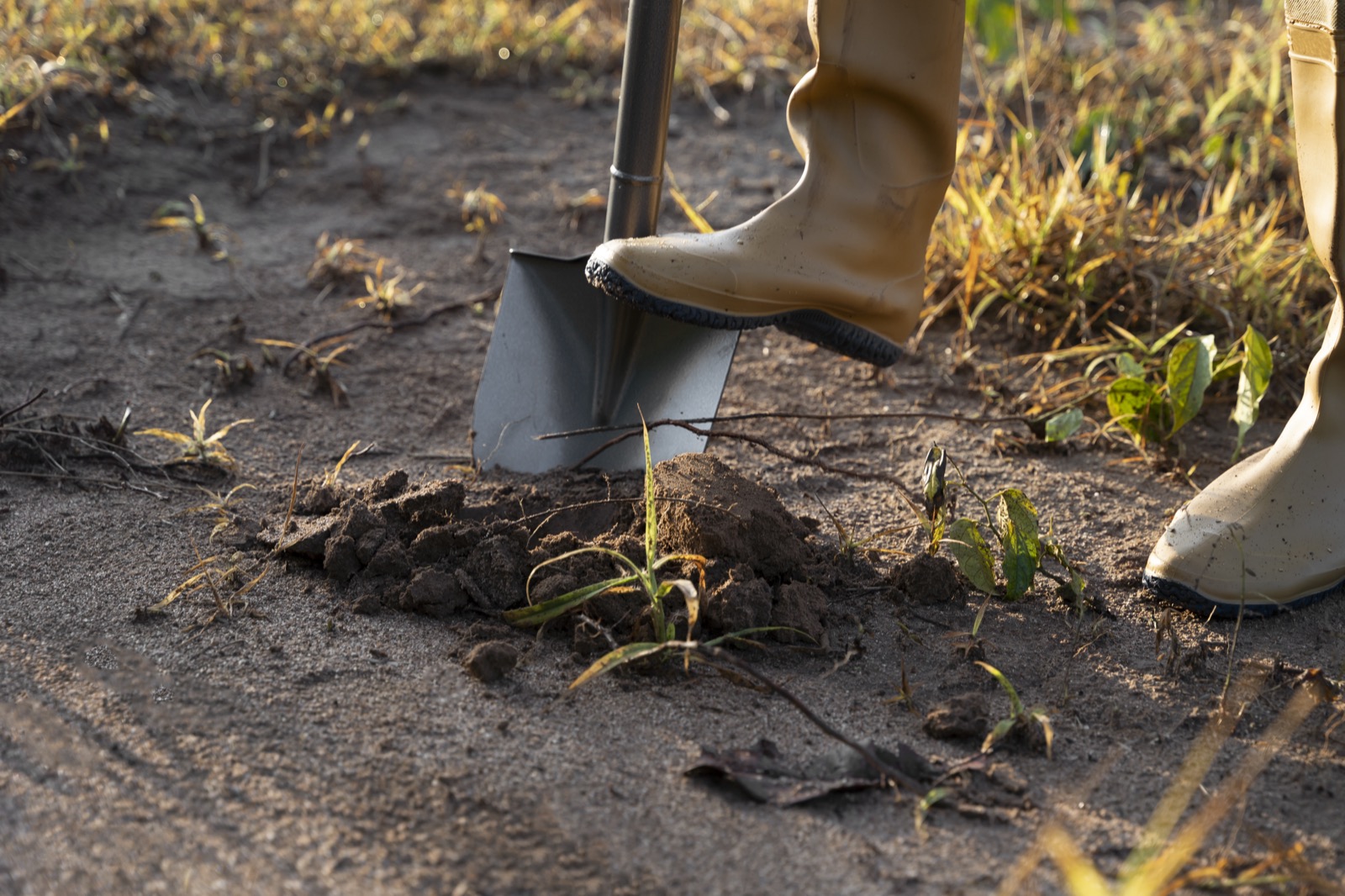
The hole should be roughly twice as wide as the root ball, and exactly as deep as the root ball is tall. If it is deeper, the sapling will sink over time and the root collar will end up underground, which is a common cause of rot.
Don't throw away the soil you dig out. Mix it with mature compost, roughly three parts soil to one part compost, and use it to backfill the hole.
2. Loosen the roots, don't leave them pot-shaped
If the sapling comes in a container, the roots are almost always wound in a circle. That circle needs to be broken: loosen the outer layer with your fingers, and if it is tightly packed, make three shallow cuts with a knife along the height of the root ball. It sounds rough, but this way the roots grow outward instead of continuing to strangle themselves.
Set the sapling so that the root collar, the spot where the trunk turns into roots, is level with the surrounding ground or two to three centimeters above it.
3. The stake goes in before you backfill
The stake is driven in on the side of the prevailing wind, before the hole is filled, so it doesn't pierce the roots. Tie it with a soft strap in a figure eight, loose enough that the trunk can sway a little. A rigidly tied trunk doesn't develop strong wood.
4. Watering is not a one-time thing
Right after planting comes a generous watering, ten to twenty liters, slowly, so the water reaches deep down. Then, during the first season, the same amount once a week, and twice a week in a drought. Shallow watering every day is worse than nothing, because the roots stay near the surface.
5. Mulch, then leave it alone
A layer of mulch five to seven centimeters thick, bark, hay or wood chips, holds moisture and keeps weeds down. The mulch must not touch the trunk itself, leave a gap of a few centimeters around it.
That's all. From here the sapling does the work on its own, and you come back for watering and to check the ties, which get loosened as the trunk thickens.